
Update June 21, 2011: JP Morgan Chase has agreed to pay a $154 million penalty to settle SEC charges that the bank misled investors about a complex mortgage-securities deal during the waning days of the housing boom. The SEC charged that JP Morgan neglected to tell investors that the hedge fund Magnetar helped create the deal and was betting against it. This story was the first to detail Magnetar's role.
Update October 29, 2010: This story has been corrected in response to a recent letter from Magnetar. Read their letter, along with our response.
In late 2005, the booming U.S. housing market seemed to be slowing. The Federal Reserve had begun raising interest rates. Subprime mortgage company shares were falling. Investors began to balk at buying complex mortgage securities. The housing bubble, which had propelled a historic growth in home prices, seemed poised to deflate. And if it had, the great financial crisis of 2008, which produced the Great Recession of 2008-09, might have come sooner and been less severe.
At just that moment, a few savvy financial engineers at a suburban Chicago hedge fund helped revive the Wall Street money machine, spawning billions of dollars of securities ultimately backed by home mortgages.
When the crash came, nearly all of these securities became worthless, a loss of an estimated $40 billion paid by investors, the investment banks who helped bring them into the world, and, eventually, American taxpayers.
Yet the hedge fund, named Magnetar for the super-magnetic field created by the last moments of a dying star, earned outsized returns in the year the financial crisis began.
How Magnetar pulled this off is one of the untold stories of the meltdown. Only a small group of Wall Street insiders was privy to what became known as the Magnetar Trade. Nearly all of those approached by ProPublica declined to talk on the record, fearing their careers would be hurt if they spoke publicly. But interviews with participants, e-mails, thousands of pages of documents and details about the securities that until now have not been publicly disclosed shed light on an arcane, secretive corner of Wall Street.
According to bankers and others involved, the Magnetar Trade worked this way: The hedge fund bought the riskiest portion of a kind of securities known as collateralized debt obligations -- CDOs. If housing prices kept rising, this would provide a solid return for many years. But that's not what hedge funds are after. They want outsized gains, the sooner the better, and Magnetar set itself up for a huge win: It placed bets that portions of its own deals would fail.
Along the way, it did something to enhance the chances of that happening, according to several people with direct knowledge of the deals. They say Magnetar pressed to include riskier assets in their CDOs that would make the investments more vulnerable to failure. The hedge fund acknowledges it bet against its own deals but says the majority of its short positions, as they are known on Wall Street, involved similar CDOs that it did not own. Magnetar says it never selected the assets that went into its CDOs.
Magnetar says it was "market neutral," meaning it would make money whether housing rose or fell. (Read their full statement.) Dozens of Wall Street professionals, including many who had direct dealings with Magnetar, are skeptical of that assertion. They understood the Magnetar Trade as a bet against the subprime mortgage securities market. Why else, they ask, would a hedge fund sponsor tens of billions of dollars of new CDOs at a time of rising uncertainty about housing?
Key details of the Magnetar Trade remain shrouded in secrecy and the fund declined to respond to most of our questions. Magnetar invested in 30 CDOs from the spring of 2006 to the summer of 2007, though it declined to name them. ProPublica has identified 26.
An independent analysis commissioned by ProPublica shows that these deals defaulted faster and at a higher rate compared to other similar CDOs. According to the analysis, 96 percent of the Magnetar deals were in default by the end of 2008, compared with 68 percent for comparable CDOs. The study was conducted by PF2 Securities Evaluations, a CDO valuation firm. (Magnetar says defaults don't necessarily indicate the quality of the underlying CDO assets.)
From what we've learned, there was nothing illegal in what Magnetar did; it was playing by the rules in place at the time. And the hedge fund didn't cause the housing bubble or the financial crisis. But the Magnetar Trade does illustrate the perverse incentives and reckless behavior that characterized the last days of the boom.
 At least nine banks helped Magnetar hatch deals. Merrill Lynch, Citigroup and UBS all did multiple deals with Magnetar. JPMorgan Chase, often lauded for having avoided the worst of the CDO craze, actually ended up doing one of the riskiest deals with Magnetar, in May 2007, nearly a year after housing prices started to decline. According to marketing material and prospectuses, the banks didn't disclose to CDO investors the role Magnetar played.
Many of the bankers who worked on these deals personally benefited, earning millions in annual bonuses. The banks booked profits at the outset. But those gains were fleeting. As it turned out, the banks that assembled and marketed the Magnetar CDOs had trouble selling them. And when the crash came, they were among the biggest losers.
Some bankers involved in the Magnetar Trade now regret what they did. We showed one of the many people fired as a result of the CDO collapse a list of unusually risky mortgage bonds included in a Magnetar deal he had worked on. The deal was a disaster. He shook his head at being reminded of the details and said: "After looking at this, I deserved to lose my job."
Magnetar wasn't the only market player to come up with clever ways to bet against housing. Many articles and books, including a bestseller by Michael Lewis, have recounted how a few investors saw trouble coming and bet big. Such short bets can be helpful; they can serve as a counterweight to manias and keep bubbles from expanding.
Magnetar's approach had the opposite effect -- by helping create investments it also bet against, the hedge fund was actually fueling the market. Magnetar wasn't alone in that: A few other hedge funds also created CDOs they bet against. And, as the New York Times has reported, Goldman Sachs did too. But Magnetar industrialized the process, creating more and bigger CDOs.
Several journalists have alluded to the Magnetar Trade in recent years, but until now none has assembled a full narrative. Yves Smith, a prominent financial blogger who has reported on aspects of the Magnetar Trade, writes in her new book, "Econned," that "Magnetar went into the business of creating subprime CDOs on an unheard of scale. If the world had been spared their cunning, the insanity of 2006-2007 would have been less extreme and the unwinding milder."
Magnetar Gets Started
 The guiding force behind Magnetar was Alec Litowitz, a triathlete, astronomy buff and rising star in the investing world. In 2003, Litowitz retired from a Chicago-based hedge fund, Citadel, one of the most successful in the world, where he had spent most of his career and became a top executive. He promised to stay out of the business for two years.
As he waited for his non-compete agreement to expire, Litowitz and his wife traveled through Europe collecting antiques to stock a big house they were building on the shores of Lake Michigan.
By spring 2005, Litowitz's wait was over. Then 38 years old, Litowitz quickly raised money to start his own hedge fund. The fund, Magnetar, attracted $1.7 billion from investors and opened in April.
Litowitz, who declined to be interviewed, had an approach to investing that emphasized scale and simplicity. He told those he hired: "Figure out a way to make money and figure out how to repeat it and do it over and over again," according to a former employee. The firm handed out T-shirts emblazoned with a confident slogan: "Very Bright, Very Magnetic." Employees privately joked about working for a fund named after something like a black hole.
Litowitz brought on board David Snyderman. A New Yorker with a serious mien, Snyderman, in his mid-30s, began hunting for investment opportunities in Wall Street's burgeoning market in mortgage-backed securities.
It didn't take them long to find something promising.
Snyderman and Magnetar focused on Wall Street's mortgage assembly line, which had been super-charged during Litowitz's time away from the business. Banks bundled pools of mortgages into large bonds, which they combined to create even larger investments. These were the now-infamous collateralized debt obligations. Each month, homeowners paid their mortgages. Each month, payments flowed to investors. (Here is an excellent video explaining CDOs.)
Large investors across the globe snapped up the CDOs, which took the hottest investment around -- the U.S. housing market -- and transformed it into something that supposedly had little or no risk. Wall Street preached that the risk had been diluted because it was spread out over such large collections of mortgage bonds. (CDOs can also be based on side bets that rise and fall with the value of other mortgage bonds. These are known as "synthetic" CDOs. Magnetar’s deals were largely synthetic.)
Just as they did with mortgage-backed securities, investment banks divided CDOs into different layers, called tranches. As the mortgages were paid, money flowed to investors holding the top tranche. Since they were the first to get paid, and thus took the least amount of risk, they earned low interest rates. Next came the middle levels -- the so-called mezzanine tranches.
Last in line for money were investors in what's known as the equity. In return for being at the bottom, equity investors got the highest returns, sometimes 20 percent interest -- money they would receive only as long as the vast majority of mortgage holders made their payments.
Even back then, Wall Street insiders called the equity "toxic waste," and as anxiety built in late 2005 that the housing boom was over, investment banks struggled to find takers.
To Magnetar, the toxic waste was an opportunity.
At a time when fewer investors were stepping up to buy equity, the little-known hedge fund put out the word that it wanted lots and lots of it. Magnetar concentrated in a particularly risky corner of the CDO world: deals that were made up of the middle, or mezzanine, slice of subprime mortgage-backed bonds. Magnetar CDOs were big, averaging $1.5 billion, about three times the size of earlier deals built on subprime mortgages.
Magnetar's purchases solved a crucial problem for the banks. Since the equity was so risky and thus difficult to sell, banks didn't like to create new CDOs unless someone committed to buy them. Indeed, such buyers were so crucial that Wall Street referred to them as the CDOs' "sponsors."
Without sponsors, Wall Street's mortgage bond assembly line could grind to a halt, and with it bank profits and banker bonuses. A top CDO banker could earn $3 million to $4 million annually on the CDOs he created and sold.
Usually, investment banks had to go out and find buyers of the equity. With Magnetar, the buyer came right to the bank's doorstep. Wall Street was overjoyed.
"It seemed like a miracle," says one mortgage market investment banker, because "no one" had been buying equity.
"By the end of 2005, the general sense was that the CDO market would slow down. These trades continued to fuel the fire," says Bill Tomljanovic, who worked for a firm that helped build a Magnetar CDO. Magnetar was "a driving force in the market."
According to JPMorgan data, Magnetar's deals amounted to somewhere between a third and half the total volume in the particularly risky corner of the subprime market on which the fund focused.
Outsiders thought Magnetar was piling in at exactly the wrong time. A March 2007 Business Week article titled "Who Will Get Shredded?" would later put Magnetar near the top of its list. The hedge fund, said the magazine, "showed bad timing."
How could Magnetar hope to make money on such risky stuff? It had a second bet that was known only to insiders.
At the same time it was investing in the equity, the fund placed bets that many of the same CDOs it had helped create would actually blow up. It did that using one of the most opaque corners of the investment world: credit default swaps, which function as a kind of insurance on CDOs and other types of bonds.
Credit default swaps work roughly like an insurance policy: You pay a small premium regularly, on any bond you want -- whether you own it or not -- and if it goes bust, you get paid off in full.
Nobody but Magnetar knows the full extent of its bets. Hedge funds are private and they don't disclose the details of their trades. Also, credit default swaps are mostly unregulated and not publicly disclosed. Magnetar says it didn't bet only against its own CDOs. The majority of its credit default swaps, says Magnetar, were on other CDOs. (Update April, 9:We have added additional detail from Magnetar’s response in which the hedge fund says it was “net long” on its own CDOs, an assertion on which the fund has declined to elaborate.)
Since it was the sponsor, Magnetar had privileges. Placing the risky equity was so important to banks that they typically gave those who bought it a say in how the deal was structured. Like all investors, equity buyers had to weigh risk and reward, the goal being to maximize returns while minimizing the chances that your investment will blow up.
But people involved in Magnetar's deals say the hedge fund took a different tack, pushing for riskier bonds to go inside its CDOs. Doing that would make it more likely that Magnetar's bets against the CDO would pay off.
The equity bought by Magnetar represented just a tiny fraction of the overall CDO. If it costs, say, $50 million, an entire CDO could be 20 times that, $1 billion. And if the CDO begins to go south and you're smart enough to have taken out enough insurance, you can make hundreds of millions of dollars. That, of course, would take a bit of the sting out of losing your original $50 million investment in the equity.
Magnetar Does Its First Deal
As Magnetar set up its CDO shop, the hedge fund hired Jim Prusko, a smart and affable investor who had worked previously at the Boston money-manager Putnam Investments. He would shoulder much of the work of courting Wall Street bankers and managers who worked with the hedge fund. He operated out of Magnetar's office in midtown Manhattan around the corner from Saks Fifth Avenue. In an office of 20-somethings, Prusko, then 40 years old, stood out as the "old man."
Prusko and his boss at Magnetar, Snyderman, began approaching investment banks, offering to buy the riskiest, highest-yielding portion of CDOs. They always wanted a middleman, known as a CDO manager, on their deals. Many CDOs are operated day to day by such independent firms, who are often brought in by investment banks.
The managers also played a vital role in creating deals. When an investment bank created a CDO, it would often give what amounted to blueprints to the managers, who would then go out and find the exact bundles of bonds to fill the CDO. The managers had a fiduciary duty to represent the CDO fairly to all investors, ensuring investors got accurate and equal information.
Magnetar's deals were numerous and big, and just like for investment banks, the bigger the deal, the larger the fee for managers.
"Prusko's job was to butter up the CDO managers and the bankers," said one banker who dealt with him.
By relying on a manager rather than managing the deal itself, Magnetar had no legal obligations to the CDO or others who bought it.
 Magnetar completed its first deal in May 2006. In what became a habit, it named the CDO after a constellation, in this case, "Orion," known for the trio of stars that form the mythological Greek hunter's belt. For its maiden CDO, Magnetar enlisted a partner to buy risky equity alongside it, an internal investment fund within Deutsche Bank.
Deutsche and Magnetar didn't reach for a Wall Street powerhouse to put the deal together. Instead the investors worked with Alex Rekeda, a young Ukrainian immigrant who was then working for Calyon, the investment banking arm of the French bank Crédit Agricole.
Magnetar and Deutsche were deeply involved in creating Orion. "We want to make sure we control the deal," a banker who worked on it recalls them emphasizing.
One person involved in Orion recalls Deutsche's point person, Michael Henriques, and Magnetar's Prusko pressuring the CDO manager, a division of the Dutch bank NIBC, to include specific lists of bonds in the deal.
Prusko and Henriques told this person that the investors "needed more spread in the portfolio." More "spread" means more return and more risk.
This person recalled Magnetar asking, "Would you consider these bonds?" Their suggestions were invariably for riskier bonds. "Let's just say we didn't think their suggestions made a lot of sense," the person said.
He said the CDO manager refused Magnetar's requests to put riskier bonds in the deal. Still, it was an eye-opening experience. "I began to realize there were things you had to defend yourself against," he said.
Magnetar and Deutsche declined to comment on Orion specifically. Magnetar says it made suggestions about the general outlines of the CDOs. But, the hedge fund says, it "did not select the underlying assets of the CDO at any time prior to or subsequent to transaction issuance."
Other buyers of the CDO could have figured out they were getting relatively risky bonds, but they would have had to look hard at the minutiae of the deal. By this point in market history, the ratings had less and less meaning. Two sets of bonds rated AA could have very different levels of risk. Most investors chose not to dig too deeply.
One investor in Orion was a fund affiliated with IKB, a small German bank. Eventually, it invested in at least four more Magnetar deals. In mid-2007, because of the disastrous investments in subprime securities, the German government was forced to bail out IKB. The failure of the bank was an early warning sign of the global financial crisis.
Deutsche's Henriques would later quit the bank and join Magnetar.
Orion lost value but never defaulted. That was better than every subsequent CDO that Magnetar helped create, according to ProPublica's research.
Magnetar's (Nearly) Perpetual Money Machine
By buying the risky bottom slices of CDOs, Magnetar didn't just help create more CDOs it could bet against. Since it owned a small slice of the CDO, Magnetar also received regular payments as its investments threw off income.
With this, Magnetar solved a conundrum of those who bet against the market. An investor might be confident that things are heading south, but not know when. While the investor waits, it costs money to keep the bet going. Many a short seller has run out of cash at the gates of a big payday.
Magnetar could keep money flowing -- via its small investments in CDOs -- and could use that money to pay for its bets against CDOs.
Similar, commonly traded, assets appeared in multiple Magnetar CDOs. Experts say the benefit of that overlap to Magnetar was that when the hedge fund bet against non-Magnetar CDOs, the CDOs still had similar characteristics to the ones Magnetar had invested in.
Soon enough, bankers and CDO managers had a sense of how it worked. "Everyone knew," said one person who managed Magnetar CDOs. "They used the equity to fund the shorts."
Magnetar further increased its odds by insisting that the CDOs it helped create had an unusual construction. Typically, cash flowing to the last-in-line equity buyers is cut off at the first signs of trouble -- such as a rise in mortgage delinquencies. Those at the top of the CDO -- who accepted lower returns for less risk -- received that cash, leaving none for the high-risk holders.
Magnetar wanted its deals to be "triggerless," meaning lacking these cash-flow dams. When the market turned shaky and homeowners began to default, money kept flowing down to the risky slices that Magnetar owned.
Even today, bankers and managers speak with awe at the elegance of the Magnetar Trade. Others have become famous for betting big against the housing market. But they had taken enormous risks. Meanwhile, Magnetar had created a largely self-funding bet against the market.
E-mails Give Glimpse of How Magnetar Worked
 By the fall of 2006, housing prices had already peaked and Magnetar's assembly line started producing, helping to create CDOs it would bet against. The hedge fund's appetite seemed insatiable. The deals were the talk of CDO desks across Wall Street.
Between the end of September and the middle of December 2006, Magnetar had a hand in spawning at least 15 CDOs, worth an estimated $23 billion. Among the banks involved with those deals were Citigroup, Lehman Brothers and Merrill Lynch.
E-mails obtained by ProPublica from that time suggest Magnetar's clout. The firm was involved at the start of deals and pushed for riskier bonds to be included.
After Magnetar expressed interest in buying the equity, the French bank Société Générale began to build the CDO, and selected a New York-based manager, Ischus Capital Management, which would choose the exact bonds to go into the CDO.
Magnetar wanted to name the CDO after a small constellation in the southern sky called Hydrus, which means "male water snake." But by late September, Magnetar and Ischus began sparring over the composition of the deal.
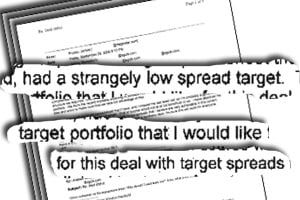
Magnetar pressed Ischus to buy lower-quality assets for the deal, according to three people familiar with Hydrus. In an e-mail to bankers at Société Générale and Ischus executives, Magnetar's CDO specialist, Jim Prusko, wrote on Sept. 29, 2006, "The original portfolio target spreadsheet that I have... had a strangely low spread target. That of course would not at all be beneficial to us. I have attached the target portfolio that I would like for this deal with target spreads."
The portfolio Magnetar outlined didn't list specific bonds, but executives at the CDO manager Ischus felt that they understood what Prusko wanted. A request for higher-spreading assets means more risk in the deal.
Andrew Shook, an Ischus executive, answered forcefully on Oct. 3, "We will not assemble a portfolio we are not proud of and feel strongly about in the name of a spread target."
Prusko dialed down the pressure, responding within an hour. "Of course, the actual security selection is totally your purview," he wrote. "I just wanted to make sure the overall portfolio characteristics worked for our strategy."
Shook declined to comment on the e-mail exchange. Magnetar says that the deal as originally conceived wouldn't have been profitable and that it was merely trying to get a higher return -- a higher "spread" -- to balance out the risk it was taking in owning the bottom-rated slice of the CDO.
The two sides subsequently drifted apart, partly over Ischus's unease with Magnetar's pressure, and the deal was never completed.
Concerns About 'Reputational Risks'
 As part of the big business Magnetar was doing in the fall of 2006, the hedge fund put together a CDO with Lehman Brothers named for the constellation Libra. John Mawe, a banker who worked on Libra, remembers that "there was a back-and-forth fight" about the assets between the bank's CDO manager and Magnetar, with the hedge fund pushing for riskier assets.
Mawe says Lehman's CDO in-house-management arm, which handled the deal, never put assets into Libra that it thought were bad investments.
Among the other banks that Magnetar approached during that time was Deutsche Bank, with whom it had teamed up to do its first deal months earlier. Deutsche Bank was anxious for business in order to maintain its standing as one of the top CDO banks, according to one of its bankers. Deutsche recommended CDO manager State Street Global Advisors.
The State Street managers were "highly skeptical" of doing a deal with Magnetar, according to one participant. "State Street wanted their deals to do well," said the participant, and with Magnetar, there was "a lot of reputational risk to be concerned about."
Hoping to close the deal, Magnetar's master salesman Jim Prusko drove up from his home in the New York suburbs to State Street's headquarters in Boston, to mollify executives in the management team. After the meeting, the deal went forward. As one banker explained, "there were other managers who were dying to do this deal" and get the millions in fees.
After subprime losses, State Street closed the business that managed its CDOs in late 2007. Frank Gianatasio, who worked in State Street's CDO business says, "We were comfortable with every transaction we put into our CDOs."
Deutsche, Magnetar and State Street called the $1.6 billion CDO they created Carina, a constellation whose name in Latin means a ship's keel. In November 2007, Carina had the distinction of being the first subprime CDO of its kind to be forced into liquidation.
State Street and Magnetar declined to comment on their negotiations over Carina.
A Lawsuit Suggests Merrill Lynch's Role
 By early 2007, the mortgage market was falling apart. Lenders were reporting big losses, delinquencies were mounting -- and Magnetar's business was booming.
Between late February and April, banks rolled out five Magnetar-sponsored deals, with a value of about $7.2 billion. Among them was a $1.5 billion CDO named Norma. Following Magnetar's branding convention, Norma is a constellation in the Southern Hemisphere named for the Latin word for "normal." This CDO was anything but.
Details about Norma, which was created by Merrill Lynch, have emerged through an ongoing lawsuit between Merrill and Dutch bank Cooperatieve Centrale Raiffeisen-Boerenleenbank, known commonly on Wall Street as Rabobank. (The Wall Street Journal had the first detailed report of Norma, in late 2007.) The dispute involves a side transaction that Rabobank made with Merrill involving Norma. Magnetar is not a party to the litigation. Yet the allegations are scathing in their depiction of how the CDO was developed.
"Merrill Lynch teamed up with one of its most prized hedge fund clients -- an infamous short seller that had helped Merrill Lynch create four other CDOs -- to create Norma as a tailor-made way to bet against the mortgage-backed securities market," the complaint reads. (Emphasis in the original.)
"[T]o facilitate the selection of assets that would allow Norma to operate as a hedging instrument rather than an investment vehicle, Merrill Lynch hand-picked a beholden collateral manager that was willing to ignore its fiduciary duties to Norma's investors."
The manager for Norma was a small shop out of Long Island, N.Y., called NIR Capital Management. Run by Corey Ribotsky, the firm's primary line of business before entering CDOs was speculating in penny stocks.
NIR brought in a team of experienced bankers to run its CDO business. The firm also had a variety of other ventures. At one point, they put money into a documentary called "American Cannibal," that profiled the aborted launch of a reality television show in which contestant were stranded on an island and goaded into cannibalism. (The New York Times found it "absorbing.") Ribotsky is now under investigation by federal authorities for misleading clients about its investment returns. NIR and Merrill Lynch declined to comment on dealings with Magnetar; Merrill Lynch denies liability in the litigation. Magnetar declined to comment.
Norma began to suffer setbacks even before the deal closed in March 2007. According to the lawsuit, by the time Norma was completed, its value had already declined by more than 20 percent.
JPMorgan Gets Into the Game -- And Loses
 Despite the bad news in the mortgage market, Magnetar continued to find a few willing bankers to do CDOs, including a new one: JPMorgan Chase.
JPMorgan had avoided many of the complex financial transactions that decimated the banking industry. As the market grew frothier, JPMorgan pulled back from the CDO business. In 2005, the men who ran JPMorgan's CDO unit told their bosses that they couldn't see how to complete a CDO without sticking the bank with the large top tier, which would not appeal to investors because of its low returns. Other banks dealt with this problem by retaining these CDO layers on their books.
But by mid-2006, JPMorgan joined the herd. It hired bankers to expand its CDO team and got to work.
A few months later -- in early 2007 -- Magnetar and JPMorgan banged out a deal. Unlike the earlier CDOs Magnetar helped create, this one wasn't named after a constellation. Instead, the deal was called “Squared,” after the term for a CDO that was made up of other CDOs. Squared was filled in part with other CDOs Magnetar had helped create.
According to a person familiar with how the deal came together, Magnetar committed to purchase $10 million worth of Squared's equity. Magnetar's purchase allowed JPMorgan to create and sell a $1.1 billion CDO. As it had on previous deals, Magnetar pushed the bankers to select riskier bonds. "They really cared about it," said the person involved in the deal. "They wouldn't pull punches. It was always going to be crappier."
The hedge fund requested that Squared have slices from many Magnetar CDOs, including Auriga, Carina, Libra, Pyxis and Virgo. They all went into the deal. Magnetar also successfully pushed for Squared to include slices from one of the Abacus deals, a group of CDOs that, as the New York Times later reported, Goldman Sachs had created and bet against.
JPMorgan earned $20 million in creating Squared, according to the person involved in the deal.
JPMorgan's sales force fanned out across the globe. It sold parts of the CDO to 17 institutional investors, according to a person familiar with the transaction. The deal closed in May 2007, nearly a year after housing prices had peaked. Within eight months, Squared dropped to a fraction of its initial value.
Just about everybody lost out, including Thrivent Financial for Lutherans, a Minnesota-based not-for-profit fraternal organization, whose $10 million investment was wiped out. Thrivent declined to comment.
Small pieces of Squared, as well as Magnetar's CDO Norma, also ended up in mutual funds run by Morgan Keegan, a regional investment bank based in Memphis, Tenn.
The funds, advertised as conservative investments, cratered after betting on various exotic assets. Morgan Keegan was sued by individual investors who claimed that they were misled about the risks. Among the investors was former Chicago Bulls player Horace Grant, who was awarded $1.4 million in arbitration. This week, the SEC accused two Morgan Keegan employees of misleading fund investors about the value of its holdings in CDOs. Morgan Keegan called the charges "factually inaccurate" and promised to defend itself "vigorously." Morgan Keegan did not respond to a request for comment on the specifics of the two Magnetar CDOs.
The biggest loser was JPMorgan Chase itself, which had kept the large, supposedly safe top slices of Squared on its books, without hedging itself. The bank lost about $880 million on the CDO. JPMorgan declined to comment on the details of the transaction.
Magnetar came out a winner. The fund earned about $290 million on its bet against Squared, according to a person familiar with the deal. Magnetar declined to comment.
Magnetar's Exit: A Deal so Bad Even a Credit-rating Agency Balked
 Prusko was buoyant as Magnetar's trades began to make money as its short bets rose in value. One friend recalls Prusko ribbing him: "What are you going to do after this blows up?" (Magnetar declined to comment on the exchange.)
In the spring of 2007, Magnetar began to have a problem: The hedge fund was sitting on hundreds of millions of dollars' worth of CDO equity and other low-rated portions of its deals. With the decline of housing prices accelerating, off-loading these pieces would be very hard.
Magnetar needed a buyer and some deft financial engineering. It found the answer through its former partner, Alex Rekeda, who had been the banker on Magnetar's first CDO. Rekeda now worked at Mizuho, one of Japan's biggest banks. Mizuho was eager to get into the CDO world. It hired Rekeda in part because he could bring Magnetar's business, according to one CDO manager who worked with him.
Rekeda and Magnetar came up with a remarkable CDO. They took their risky portions of 18 CDOs they had helped created -- and repackaged them to sell them to others. Bundling up the dregs of a CDO was rare, if not unprecedented.
This deal, Tigris, which closed in March 2007, tied together $902 million of Magnetar's risky assets. Rekeda convinced two rating agencies, Standard & Poor's and Fitch, to rate it. Fitch designated $259 million of it as triple A, the highest rating. S&P rated nearly $501 million as triple A. (When contacted for this article, S&P said it was comfortable rating Tigris; Fitch didn't respond to questions about the deal.)
In a highly unusual move, the third major rating agency, Moody's, refused to rate Tigris. Rekeda lobbied Moody's for a rating, according to a person familiar with the deal. But Moody's then-head of CDOs, Eric Kolchinsky, wouldn't budge.
Magnetar got $450 million from Mizuho, which in return received income from assets in Tigris, according to several people familiar with the transaction. It was what's known as a non-recourse loan: If things went wrong, Mizuho could only lay claim to what was in Tigris.
In response to ProPublica's questions about this deal, Magnetar said the fund "as a matter of general practice, and as do most hedge funds, enters into non-recourse financing on specific assets in its portfolio."
By September, just six months after Tigris had been created, Fitch downgraded most of the CDO's slices. By the end of January 2008, the CDO had gone into default. The Japanese ended up with the paper, which was worthless. Mizuho eventually wrote Tigris off, as part of about $7 billion in total losses from its subprime missteps. Mizuho declined to comment, as did Magnetar.
Just as with a refi gone bad, when Tigris was wiped out, the hedge fund walked away from the house -- in this case its collateral. A person who worked on Tigris boasted about how innovative the deal was. If it hadn't blown up, he says, it would have been "deal of the year." For Magnetar, it may have been.
Records it shared with investors show Magnetar had a spectacular 2007. Founder Alec Litowitz pulled down $280 million, according to Alpha Magazine. That spring, a trade journal awarded Prusko and Snyderman "Investor of the Year" honors. The Magnetar Constellation Fund, the firm's fund that had the most exposure to the CDO trades, was up 76 percent in 2007, according to a presentation Magnetar gave to investors in early 2009. The main fund, the Magnetar Capital Fund, was up 26 percent that year. By the end of 2007, Magnetar had $7.6 billion under management, up from the $1.7 billion it began with two years earlier. Magnetar declined to comment on its performance.
ProPublica has learned that the SEC has been looking into how the Magnetar deals were created, but it's not clear how much progress the investigation has been made or who might be the target. In a statement yesterday, Magnetar said:
Our understanding is that for some time, the SEC staff has been looking broadly at the sales, marketing, and structuring of CDOs. In connection with that inquiry, the SEC staff has from time to time requested information from Magnetar and other market participants, and Magnetar has been cooperating and responding to the requests. We are not aware that this inquiry is focused on any particular person or firm.
ProPublica Research Director Lisa Schwartz and researcher Kitty Bennett contributed to this story. ProPublica’s Ryan Knutson also helped with research. Finally, a big thanks to This American Life’s Alex Blumberg.
Correction, April 9, 2010: This story previously suggested that the hedge fund Magnetar was involved in the naming of “Squared,” a JP Morgan Chase collateralized debt obligation. In a September 30, 2010 letter to ProPublica, Magnetar said it did not name the CDO, and we have corrected the story to remove the previous suggestion.


