We wrote last week
about Democratic volunteers in Minnesota who feed information about their neighbors into the party’s
voter database.
The data points they
collect — like the campaign lawn sign in front of a voter’s house, or a
political opinion shared in a letter to the editor — are saved from one
election cycle to the next, and often shared with the Democratic National
Committee.
These little pieces
of information may not seem particularly useful on their own. But taken
together, they can be quite telling.
Minnesota voters do not register with a
political party, so there’s no easy way to tell a Democrat from a Republican
from public voter data. But using the information they collect in their
database, Minnesota’s Democratic-Farmer-Labor party can get a clear view of
both their supporters and their opponents.
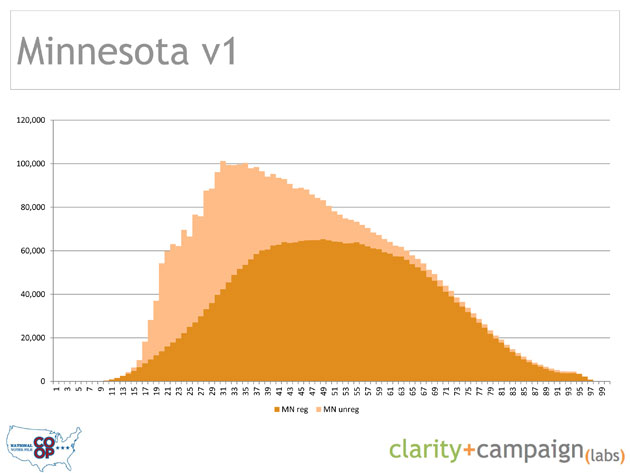
Here’s a graph of the
political orientation of Minnesota voters, produced by Clarity Campaign Labs, a
Democratic firm, this past summer. The graphs show voters’ estimated political
leanings, on a scale of 1 (strong Republican) to 100 (strong Democrat),
according to Tom Bonier, the company’s co-founder.
This graph was made
using public voter data, consumer data, and demographic information. Without any
party registration data, most Minnesota voters appear to be lumped together in
the middle of the political spectrum.
Then Clarity crunched
the numbers again—this time working using the voter information
Minnesota’s Democratic volunteers had painstakingly collected over more than
two decades.
In this new graph,
most of those middle-of-the-road voters disappeared. Instead, the state’s
citizens are sorted into two tall columns of strong Republicans and strong
Democrats.
(The lighter-orange
spike in the middle of this graph represents Minnesota residents who are not
registered to vote; their leanings are still difficult to categorize.)
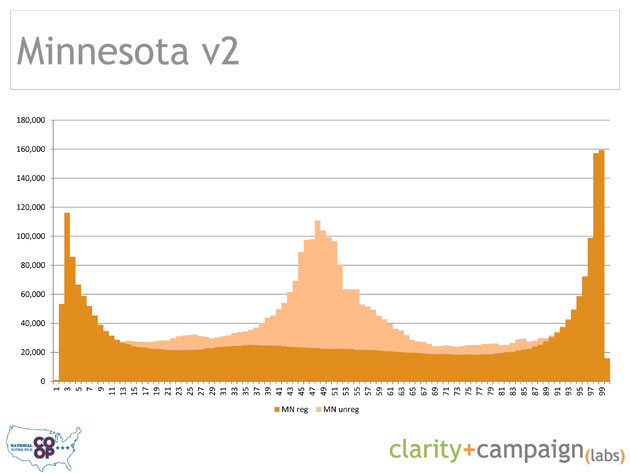
The contrast between
these two graphs showed Minnesota Democrats how well their investment in data
collection has paid off. In a
closely divided state, they can use their database to pinpoint potential supporters
and avoid spending money or volunteer hours trying to reach voters who are
likely to be conservative.
Even in states where
campaigns can contact voters based on their official party registration, a data
collection strategy can still be useful. Gathering information about voters can
help campaigns make an educated guess about the political leanings of
registered independents. It can also help Democrats figure out whether a
registered GOP voter is a strong Republican, who is unlikely to change her
mind, or a weak Republican, who might vote for a Democrat in certain
situations.
In conservative Utah,
most voters are Republicans. Public voter data revealed few people who were
likely Democrats.

But using data
gathered by the Utah Democratic Party, Clarity Campaign Labs was able to
surface a larger group of voters—including some registered independents—who
were very likely to vote
Democratic.
Some voters in this
group may have been directly identified through records of political donations
or conversations with Democratic volunteers, Bonier said. Others are “look-alikes,”
meaning that Clarity analyzed the characteristics of the known supporters to
project others who were very likely to be Democrats.
In his slideshow of
the graphs, Bonier noted that the Utah example proved that “there is tremendous
value in organized data collection efforts even if you’re not in a traditional
battleground.”

In order to calculate
the political leanings of voters across the nation, Clarity Campaign Labs
plugged in public voter and demographic information about individual citizens
in all 50 states, and used these data points, weighted in different ways, to
assign each person a political score.
These scores
represent the probability of a certain person being a Republican or a Democrat—
which means that even a voter who is assigned a political partisanship score marking
them as a Democrat might actually turn out to be a staunch Republican.
Assigning voters
these kinds of political scores is common: Obama’s 2012 campaign calculated several different scores for each swing state voter, including
an estimate of how persuadable they might be. Americans for Prosperity, a conservative
group, also scored voters on their likelihood of supporting tax and spending cuts, The Guardian reported.