
Jan. 8: This post has been corrected.
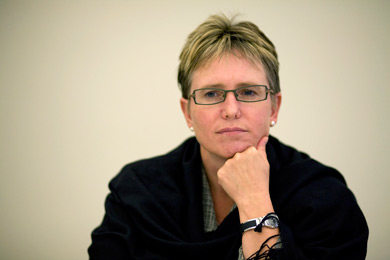
For the last decade or so, Tracy Weitz has been one of the most prominent
abortion researchers in the United States.
As director of the University of California at San Francisco’s Advancing New
Standards in Reproductive Health (ANSIRH), part of the Bixby Center for Global Reproductive Health, she has co-authored seven studies in
major journals in the past year alone, on topics ranging from how low-income
women pay for abortions to why some women who want an abortion
delay until it is too late.
This summer, one of the studies she oversaw persuaded California lawmakers to allow trained non-doctors (nurse practitioners, certified midwives,
physician assistants) to perform first-trimester abortions, possibly the
biggest expansion of abortion access since the Food and Drug Administration
approved the abortion pill in 2000.
Now, just as some of ANSIRH’s most ground-breaking work is starting to see the
light of day, Weitz is leaving the world of clinical
research. She has taken a job at an organization she declined to name but where
she hopes her impact on women’s reproductive health issues will be broader and
deeper.
Weitz recently spoke with ProPublica’s
Nina Martin. This conversation has been edited and amended for clarity and
brevity.
* * *
NM: How did abortion become the main focus of your work? What is your
background?
TW: I’m a medical sociologist by training. I started off trying to figure out
how to deliver health care services. I did that for many years as an
administrator and was frustrated that we seemed to just be rearranging the deck
chairs on the Titanic. I also have a real interest in policy and politics.
Abortion for me has always been the natural place in which all of those things
come together. It is a political issue. It is a social issue. It is a health
care issue. It is a feminist issue.
NM: What are some of the main challenges to doing abortion research in this
country?
TW: The federal government has a prohibition on funding any research that
involves abortion care. You cannot get funding from the National Institutes of
Health to study, say, abortion techniques — how to make it safer. But
this ban has been interpreted very, very broadly to preclude funding anything
involving abortion, even a topic like women’s emotional responses. That has
left the funding of research on abortion to the philanthropic community.
Now, it’s very unusual for foundations to fund clinical research. It’s not
historically what they do — research is the domain of government. But in
the last 10 years, there’s been recognition in the philanthropic community that
in order to make progress [on reproductive rights], whether culturally or
politically or in the service-delivery arena, there are research questions that
we need to answer.
This [private funding] has opened up an enormous avenue for researchers who are
interested in questions about abortion care, abortion policy, and abortion in
American culture. But it comes with its own downside, which is that people are
very suspect of research that is funded by organizations that have particular
ideological agendas.
NM: As researchers, what kind of hurdles and antagonism do you face?
TW: There’s definitely a difference between the social scientists who do the
research and the MDs who actually do abortions. Abortion doctors have had
assassinations, barricades and constant protesters. As researchers, our safety
hasn’t really been in question.
Most of the harassment comes at the level of trying to
discount our academic reputation— suggesting that anyone who does
abortion-related research who believes that abortion should be legal shouldn’t
be trusted. That somehow our science is tainted, that we haven’t used good
methods. That’s why we have a strong interest in being published in the
peer-reviewed literature. We think that the science should be open to scrutiny.
It should be put through the same kind of rigor that other clinical or social
research is.
NM: Let’s talk about the study that has probably had the greatest impact so far: the one
looking at whether trained non-doctors — nurses, midwives, physicians
assistants — can safely perform vacuum-aspiration abortions in the first
trimester. That study included nearly 20,000 patients
throughout California — one of the largest studies on abortion ever done
in the United States. The study had two key findings. First, it found almost no
difference in complication rates in abortions done by doctors versus
non-doctors. Second, the overall rate of complications for both groups was very
low — much lower than abortion opponents claim. Has the study shed light
on other abortion-related issues as well?
TW: Yes. One has to do with hospital transfers
[patients who require hospital care after having an abortion]. We were
interested in this topic, of course, because it’s a category of complication,
and you want to track it. But it wasn’t something we intended to focus on.
Then states [including Texas] started passing new laws that require physicians
who offer abortion care to have admitting privileges to hospitals. And we
realized that, thanks to [the non-doctor] study, we had very good data showing
that complications requiring transfers to hospitals are actually exceedingly
rare.
Of about 20,000 patients over several years, only four were directly
transferred.
NW: There’s a second study I want to talk about, which is known as the Turnaway
Study. It’s a long-term study looking at
what happens when women who want an abortion can’t get one. They show up at a
clinic too late and are turned away.
TW: First some background. At the Bixby Center and ANSIRH, we are driven by
three sets of issues and concerns. One is: How can care be best
delivered? That’s the question underlying the non-physician study. We’re very
interested in safety in general. Do you need to be in an ambulatory surgery center?
Do you need to have a nurse who administers anesthesia? Which kinds of cervical
preparations are safe and do the least damage to the cervix?
Two, we care a lot about women’s experiences.
We know that 1 in 3 women are going to have an abortion in their lifetime. And
choosing to be a parent or not is a big decision. Whatever a woman decides, we
want to know what can improve their outcomes. What do they need from their
social networks and their friends? What are the long-term effects of silence
and secrecy?
The third area of interest is social inequities. Where is there uneven
distribution of services, uneven distribution of economic outcomes?
The Turnaway Study arose out of the second and third
set of concerns. Abortion opponents have been pushing the idea that abortion
hurts women, that they feel regret. With 1.3 million women having an
abortion every year, it’s likely that a certain number do feel regret. That’s
the natural curve of any kind of big decision. What we want to know is: Who are
those women and what do they need?
But another of our questions was: what happens to women who wanted an abortion
but couldn’t get one? What happens to her economically, what happens to her
psychologically, what happens to her other kids? That was the underlying
question behind the Turnaway Study.
NM: Can you summarize the findings so far?
TW: The take-home from that study is that most women are having an abortion
because they say they can’t afford to have a child. And it turns out that
they’re right: Two years later, women who had a baby they weren’t expecting to
have, compared to the women who had the abortion they wanted, are three times
more likely to be living in poverty. They knew they couldn’t afford a kid and
it turns out they were correct.
NM: Can you give some specifics about how the study was designed?
TW: The principal investigator is Diana Greene
Foster, who was trained as a demographer. It is
an eight-year study and includes about 30 abortion facilities in every region
of the country. The sole criteria was that the clinic had to be isolated
— it had to be the only one within 150 miles that was willing to do
abortions up to whatever it set as its gestational limit [the latest point at
which it will terminate a pregnancy]. So if a woman was turned away from that
facility, she really had no other option. She probably was going to have that
baby.
We recruited about 1,000 women — that alone took us three years. About a
quarter were women who had been turned away and had a baby they weren’t
expecting. Approximately 500 were women who happened to be just under the
gestational limit when they arrived at the clinic so were able to get the
abortion they wanted. They were the comparison group.
We also wanted to know if women receiving earlier abortions were somehow
different. So the remaining participants — about 250 — are women
who received first-trimester abortions.
We followed the women every six months for five years — a phone interview
with a very lengthy survey that includes every question we could think of about
their mental health, their economic circumstances, using routine and
standardized tools, so we have some basis for comparison. Everyone in the study
has finished at least two years, and some women have completed their five years
and are rolling off.
NM: What has been your most eye-opening finding?
TW: The study has really exposed how hard it is to be a parent in this country.
It is a huge economic investment. And if you don’t have the economic resources
to be a parent, there’s nothing to help you.
Data from the study is also helping to answer other questions for which we have
no good research until now — for example, how women feel about mandatory
ultrasounds before an abortion and what factors contribute to some women
feeling regret afterwards.
NM: Finally, I want to talk about some preliminary research you presented at a
conference last fall, looking at how state and federal courts view the kind of
research you are working on.
TW:
ANSIRH was started specifically to ensure that health policy is grounded in
evidence. Because many laws aimed at restricting abortion were ending up in the
courts, I became interested in how judges were interpreting the science in
their legal decisions. We focused on four abortion-related issues where the
science is pretty clear — whether women are at risk for suicide after
abortion, gestational bans based on the presumption that the fetus feels pain,
ultrasound-viewing mandates, and medical abortion regimens.
We looked through over a thousand documents
— including lawsuits, briefs, rulings by courts at every level, the
scientific studies that are referenced, the CVs of the medical experts whose
work was cited. We analyzed not just the court decisions, but their language
about the scientific claims, how expert knowledge is referenced, the quality of
the research, whether the studies appeared in peer-reviewed journals —
that kind of thing. We’ve really just scratched the surface — we had no
idea how much there would be out there.
NM: What have you found?
TW: There is no
consistent standard for how science is or is not incorporated into the legal
decisions. Across the decisions, the same scientific studies are adjudicated
very differently. Overwhelmingly what we do see is political ideology
substituted for objective standards in adjudicating scientific claims. We were very disheartened to find that many of the judicial
decisions were discounting the science altogether. I think I was a little
naive. I had this idea that the courts were more objective.
Since I started this work, I’ve been intrigued to discover that there’s a whole
body of criticism —a lot of it around climate change — over whether
courts should have anything to do with science. When the D.C. federal court was
set up, all the patent cases went there. There was a recognition that these
issues were really complicated —more science-y — and you needed to
have judges who had specific expertise to decide them. Now, whether they’re
about environmental science or, in our case, health-related science, these
cases are being spread out across multiple courts, and judges with absolutely
no scientific training are being asked to make adjudications about science.
Should we be training judges to review science? Should we be thinking about
specialty courts with scientific expertise?
One of the more
troubling findings is the way that controversy has become a reason to discount
science. There’s a great book called “Merchants of Doubt” [Naomi Oreskes and Erik
Conway, Bloomsbury, 2011]. It’s about the production of scientific controversy
as a way to discount legitimate scientific research and clear-cut consensus
about tobacco or climate change, but it also applies to abortion. As the book
points out, you don’t need to disprove science anymore. All you need to do is
suggest that the science is actually in doubt. Courts will then look at and
say, “It’s a controversy, so deference should go to the Legislature,” or “It’s
a controversy, so we’ll do whatever we want.”
A contributing problem is that, in the legal context, medical experts and
scientists who do abortion or study abortion have been seen as suspect. Lisa
Harris, at the University of Michigan, has written some great stuff on what she
calls “The Legitimacy Paradox.” It goes like this: By virtue of
doing an abortion, you’re not a real doctor. Therefore, real doctors don’t do
abortions. Therefore, you have the right to regulate them because they’re not
real doctors.
NM: That brings me to the last thing I want to talk about, which is the issue
of stigmatization. That’s a major thread in your research and writings. Why is
this issue is so important to you?
TW: A stigma is a mark that makes you seen as morally suspect.It’s not
just bad. It’s bigger than bad.
In the abortion
context, stigmatization means that your position on abortion says everything
about you as a human being. To do abortion means that you are morally corrupt.
The fact that you would have an abortion means you’re a different kind of
person. And the consequences associated with disclosure — whether it’s “I
support legal abortion,” “I do abortions,” “I’ve had an abortion” — now
carry huge social weight. That leads to silence.
Now, I’m a person who fundamentally believes in doing anything that I can
to help women have their families when they want to have their families. If I
can help her figure out how she gets the contraception she wants and she picks
the partners she wants and she has the money she wants so that she never has to
have an abortion, then I’ve been a success.
But if she needs an abortion, she needs an abortion. And I’m there for her with that support. I’ve never met a woman who said, “It’s on my bucket list to have an abortion.”
I want everyone to
have every tool in their tool-box to be able to have a family, when and if they
want to. Any of those strategies are legitimate strategies. That includes
abortion.
Correction: This post originally stated that the FDA approved the morning-after pill
in 2000. The abortion pill was approved in 2000.