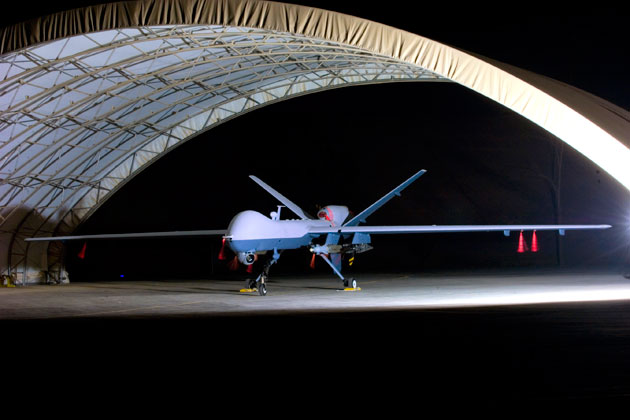

Related Interactive: Stacking Up the Administration’s Drone Claims
Drones have become the go-to weapon of the U.S.’s
counter-terrorism strategy, with strikes in Yemen in particular
increasing steadily. U.S. drones reportedly killed
twenty-nine people in Yemen recently, including perhaps ten civilians.
Administration officials regularly celebrate the drone war’s
apparent successes— often avoiding details or staying anonymous, but claiming
tacit credit for the U.S.
In June, a day after Abu Yahya Al-Libi was killed in
Pakistan, White
House spokesman Jay Carney trumpeted the death of “Al Qaeda’s Number-Two.” Unnamed officials confirmed the strike
in at least ten media outlets. Similarly, the killing of U.S. citizen Anwar
al-Awlaki by a CIA drone last September was confirmed in many news outlets by
anonymous officials. President Obama called
Awlaki’s death “a tribute to our intelligence community.”
Just last week President
Obama spoke about drone warfare on CNN, saying the decision to target
individuals for killing rather than capture involves “an
extensive process with a lot of checks.”
But when it comes to details of that
process, the administration clams up.
The government refuses
to formally acknowledge that the CIA even has a drone program, let alone
discuss its thornier elements, like how
many civilians have been killed, or how the CIA
chooses targets.
Officials have given speeches on the legal rationale for
targeted killing and the use of drones in broad terms. The administration has also
acknowledged “military operations”
outside the “hot” battlefields of Iraq and Afghanistan, but again, details have remained under wraps.
The American Civil
Liberties Union and the New York Times have both filed multiple Freedom of
Information Act requests for documents relating to the CIA’s drones. The agency
has responded by saying that it can
“neither confirm nor deny the existence of records.”
As part of a lawsuit challenging the CIA’s
response, the ACLU collected
nearly two hundred on- and off-the-record statements to the media by current
and former U.S. officials about the CIA’s use of drones for targeted killing.
In a graphic accompanying this story, we’ve laid out many of the statements,
alongside the CIA’s legal stances refusing to confirm or deny the program. The statements cover most of Obama’s first term in office. Taken
together, they show the extent to which the government keeps disclosures about
the CIA’s drone war mostly on its own terms.
In court briefs,
Justice Department lawyers argue that widespread “unofficial” discussion
notwithstanding, revealing the existence of any number of documents relating to
the drone program or targeted killing would convey sensitive information about
the nature and scope of such a program. They add that quotes from unnamed
sources or former CIA officers don’t constitute official acknowledgment. As for
public remarks about drones by President Obama and other officials—the government
argues that they never explicitly mention the CIA and could be referring to
military operations.
A federal judge in
D.C. already ruled in favor of the
CIA in one suit last
September, a decision the ACLU is appealing. A hearing is scheduled for next week.
A White House
spokesman declined to comment to ProPublica on the FOIA suit or on the CIA’s
drone program. The CIA did not respond to our requests for comment.
Some top
administration officials have become well-practiced at
coy references to the classified program.
In October 2011,
Defense Secretary—and former CIA director—Leon Panetta said, “I have a hell of a lot more weapons available
to me in this job than I had at the CIA, although the Predators aren’t bad.” In
the ACLU suit, the government argues
that Panetta’s comments were too vague to constitute an acknowledgement that
the CIA actually had drones, or whether it used them for targeted killing, “as
opposed to surveillance and intelligence-gathering.”
A year earlier, Panetta
said that Al Qaeda in Pakistan had been beaten back in part to due “the most
aggressive operation the CIA has been involved in in our history.” The
government notes that he never said the word “drone.”
Semantics aside,
details on the most controversial aspects of the program have been revealed
through a patchwork of these unofficial comments. For example, in May the New
York Times reported that the CIA counts any
military-aged male killed in a drone strike as a “militant,” even if his
identity isn’t known. Many outlets had previously reported that the CIA conducted
“signature strikes” in Pakistan, and now
in Yemen, which target men
believed to be militants whose identities aren’t known. But neither the Times
story nor subsequent reporting by
ProPublica garnered much detail
on how the CIA actually assesses casualties after a strike. As usual, neither
the White House nor the CIA would comment on the record.
It has also been widely reported that mainly the CIA conducts
strikes in Pakistan, because the U.S.’s tense
diplomatic relationship with the country requires the patina of deniability provided
by a covert program. When
Obama referred to drone strikes in a public video chat this
January, saying that that “obviously a
lot of these strikes have been in the FATA,” the Federally Administered Tribal
Areas of Pakistan, many assumed he had to be talking about the CIA.
The government insists the president’s comments didn’t count
as disclosure of anything, saying he could have been talking not about CIA
strikes but military (though, as a government brief in the
ACLU suit points out, those haven’t been acknowledged in Pakistan either). As
the government argues, “It is precisely
this sort of unbridled speculation that is insufficient to support a claim of
official disclosure.”
The same brief framed it another way: “Even if
there is speculation about a fact, unless an agency officially confirms that
fact, the public does not know whether it is so.”