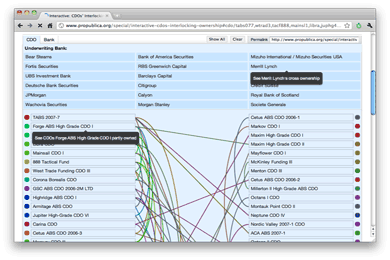
Which CDOs and Banks Had Deals With the Most Cross-ownership?
See which CDOs exchanged pieces with other CDOs through our interactive feature that reveals the incestuous nature of Wall Street’s CDO business.
As we reported last month in our story with NPR’s Planet Money, top investment banks on Wall Street created fake demand for their hottest product – mortgage-backed securities called collateralized debt obligations – in the two years before the financial meltdown. Their activity increased banker bonuses but ultimately made the crisis worse. As real investors fled the market, Wall Street’s CDO machine arranged for CDOs to buy other CDOs.
We have now created an interactive feature that lets you see for yourself one way in which the market became rife with self-dealing. As our story noted, we found 85 instances during 2006 and 2007 where two CDOs bought pieces of each other's unsold inventory. These trades, which involved $107 billion worth of CDOs, approximately a fifth of the market, underscore the extent to which the market lacked real buyers. Often the CDOs that swapped purchases closed within days of each other.
The incestuous trades made the CDOs more intertwined and thus fragile, accelerating their decline in value that began in the fall of 2007 and deepened over the next year.
Using the interactive feature, you see exactly which CDOs owned pieces of each other, which banks underwrote the deals, and which supposedly independent managers were involved in the CDOs. (You can also download our data.) Not surprisingly, the most cross-ownership occurred in the CDOs built by the top CDO banks: Merrill Lynch, Citigroup and UBS. Merrill, the leader in CDO production, had 20 CDOs that exhibited cross-ownership during 2006-2007. Here is a graphic from our interactive feature showing just how often Merrill CDOs owned pieces of each other. (In response to our questions for our story, Bank of America, which now owns Merrill, declined to discuss specific deals, noting that the CDO unit was “discontinued by Merrill before Bank of America acquired the company.")
The CDO with the most cross-ownership during the time was Tabs 2007-7. Created by UBS bank, Tabs owned pieces of four other CDOs that in turn owned pieces of Tabs. UBS declined to comment for our story.
If you look at the data itself, you can see small managers often engaged in cross-ownership. While small, these managers managed a high volume of CDOs in a short period of time. In particular, two CDO managers closely affiliated with Merrill – Harding Advisory and NIR Capital Management – had multiple instances of cross-ownership. Five Harding deals swapped pieces with other CDOs, as did three NIR deals. Both Harding and NIR declined to comment for our story about issues of cross-ownership. Another CDO manager that engaged in cross-ownership was Tricadia, which the New York Times reported bet against the very CDOs it was managing.
The Story So Far
As the housing market started to fade, bankers and hedge funds scrambled for ways to maintain the lavish bonuses and profits they had become so accustomed to, repackaging mortgages in complex securities called collateralized debt obligations. The booming CDO market masked how weak the housing market was, and exacerbated its collapse.
Latest Stories in this Project
- Yet Another Bank Fined for a Magnetar Deal, With Yet More Revealing Emails
- Emails Give Glimpse Into Deals That Fueled Financial Meltdown
- The Magnetar Fallout: Who’s Been Charged, Has Settled, or is Now Being Investigated?
- How Bank of America Execs Hid Losses -- In Their Own Words
- Four Whistleblowers Who Sounded the Alarm on Banks' Mortgage Shenanigans
Get Updates
Our Hottest Stories
- Bank of America Lied to Homeowners and Rewarded Foreclosures, Former Employees Say
- Time Out: Federal Complaint Alleges Rampant Abuse in Texas Truancy Program
- In Westchester, Progress on Housing and the Specter of Another Fight
- Worried about the Mass Surveillance? How to Practice Safer Communication
- Walmart Accepted Clothing from Banned Bangladesh Factories
- When Interns Should be Paid: A #ProjectIntern Explainer
- Without a Final Map, New York Rebuilds on Uncertain Ground
- Five Ways Congress is Trying to Curb Rape in the Military
- Objection Overruled: Top Prosecutor Must Testify in Wrongful Conviction Case
- Rape and Other Sexual Violence Prevalent in Juvenile Justice System
- Bank of America Lied to Homeowners and Rewarded Foreclosures, Former Employees Say
- The NSA Black Hole: 5 Basic Things We Still Don’t Know About the Agency's Snooping
- Walmart Accepted Clothing from Banned Bangladesh Factories
- The Best Stories on the Government’s Growing Surveillance
- Worried about the Mass Surveillance? How to Practice Safer Communication
- Betting Against the Future: How Industry Loses When Interns Go Unpaid
- Five Ways Congress is Trying to Curb Rape in the Military
- Remember When the Patriot Act Debate Was All About Library Records?
- A Father’s Day Remembrance
- Unpaid Interns Win Major Ruling in 'Black Swan' Case — Now What?


3 comments
Geme Calman
Sept. 22, 2010, 1:19 p.m.
Bravo, ProPublica!
Sal
Sept. 22, 2010, 8:06 p.m.
2 Related Points and a Q - 1) Most people before they invest typically do some research about the company or asset they are buying. At industry conventions it was common to sit down with other CDO companies and listen to their story and their strategy. It was difficult to meet all the new shops as they were proliferating very quickly. If your deal was being warehoused by UBS, it was easy to meet all the other managers who were also currently working with UBS. Then when it came time to buy bonds for your deal, you would first look at the CDOs being built by groups you had researched. They in turn had researched your operation at that same meeting and might be likely to buy bonds from the deal(s) you were building. There was no quid pro quo. It was not nefarious as some are implying. 2) Have they discussed the “Arb” anywhere in any of these articles? In order to earn enough yield for the CDO deal being built, it was necessary to buy some CDO tranches. There was a balance required between the ratings on the overall portfolio and the yield offered. Q.) If UBS was 10% of the industry issuance, would it be OK to have 10% UBS CDOs in the deal or would that be a sure sign of self dealing?
Al Allthetime
Sept. 23, 2010, 10:09 p.m.
What about the units of these investment banks dedicated to counterparty trading to harvest the small investor’s value, especially that of their own customers! And, the units who are trading in physical gold, even bidding in Ebay to vacuum as much up as possible?
Commenting on this story is closed.