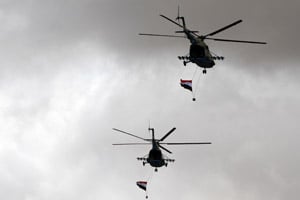
In late October, Syria asked Iraqi
authorities to grant air access for a cargo plane transporting refurbished
attack helicopters from Russia, according to flight records obtained by
ProPublica. With
Turkish and European airspace off limits to Syrian arms shipments, the regime
of Bashar al-Assad needs Iraq’s air corridor to get the helicopters home, where
the government is struggling to suppress an uprising.
Iraq regained control of its airspace
from the U.S. military just a year ago and has been under intense diplomatic
pressure from the United States to isolate the Syrian regime. Turkey says it
has closed its airspace to Syrian flights, and if Iraq did so, Syria would be
virtually cut off from transporting military equipment by plane. European Union
sanctions have already constricted arms transport by sea and air.
But it is unclear whether Iraq permitted
the fly-overs described in the documents. The Syrian cargo plane scheduled to
pick up the helicopters did not land or take off from Moscow at the appointed
times this month, suggesting that those flights did not happen.
Some of the flight request documents have been posted by
hackers associated with the online collective Anonymous and formed the basis of
a Time
story Thursday. Other documents were obtained separately by ProPublica,
which reported Monday that Syria appears to have flown 240
tons of bank notes from Moscow this summer. The authenticity of the
documents in either cache could not be independently verified.
But
taken together, the documents appear to contain new information. They show that
Baghdad has requested several times to inspect other Syrian flights that were
going to pass over Iraq from Iran and Russia, something that U.S. officials
confirmed to ProPublica.
According
to an overflight request form dated Oct. 30, the helicopter the Syrians were going to
pick up is an Mi-25, a Russian-made gunship that experts liken to a cross
between an Apache and a Black Hawk helicopter because it can fire from the air and
transport troops.
“Mi-25s
are very important to the Syrian Air Force effort against the rebels,” said
Jeffrey White, former chief of the Middle East intelligence division for the
Defense Intelligence Agency and now at the Washington Institute for Near East
Policy. “It’s a heavily armored military helicopter, which makes it very
difficult for the rebels to shoot down.”
Videoshave been posted online that appear to show Syrian Mi-25s attacking rebels, and Syria has reportedly been struggling to maintain the helicopters.
Still,
the documents leave many questions unanswered. Crucially, it is not known
whether the overflights actually happened.
A
U.S. diplomatic official told ProPublica
that the United States has been working with the Iraqi government to stop such
flights. “We have urged them directly to insist that the inspection of
those flights occur or deny overflight rights,” the official said. “We have
raised this concern and they have taken a couple steps in the right direction
— either denying overflight rights if they believe arms are being shipped
to Syria or insisting on an inspection.”
But,
State Department and Pentagon officials have not provided information on the
particular request made in the documents. Iraqi and Russian officials did not respond
to questions.
The
first two flights were scheduled for Nov. 21 and Nov. 28, but a photographer
hired by ProPublica did not observe the cargo plane at the Moscow airport where
it was supposed to land and then take off just three hours later. Nor could the
flights be confirmed with international tracking services that have recorded
the plane’s movements in the past.
Two
more flights are scheduled for Dec. 3 and Dec. 6 , according to the records.
The
Assad regime has been trying to suppress a popular uprising for almost two
years. Tens of thousands of people have reportedly died in the fighting. On Thursday, dispatches described intense clashes
on the main road to the Damascus International Airport, and at least one
airline was reported to have canceled flights. Most of the Internet in the country was shut down as
well.
Russia’s
prime minister, Dmitri Medvedev, said this week in an interview with the French
newspaper Le Figaro that arms shipments are part of a longstanding contract
with the Syrian military to repair equipment for “defense against an external
aggression.”
“We
must fulfill the obligations connected to our contracts,” Medvedev said, noting
that Russia has faced a legal conflict after suspending some arms deliveries to
Iran.
Syria
has found it increasingly difficult to transport helicopters. In June, a ship
carrying three Mi-25 helicopters from Russia to Syria was forced to turn back after the ship’s insurer withdrew coverage in response to sanctions. A
month later, a second attempt to deliver the helicopters by sea was aborted.
The
newly obtained flight documents show that Syria planned to use its Ilyushin IL-76
cargo plan to pick up helicopters at Ramenskoye Airport, also known as
Zhukovsky Airport, near Moscow. The manifest describes the cargo as an “old helicopter after
overhaulling [sic].” A second document, sent to the Syrian embassy in Baghdad, identifies
the helicopters as Mi-25s.
Officials
at Russian Helicopters, which makes the Mi-25, and Ilyushin, which makes the IL-76,
said one Mi-25 with its blades removed would fit into an IL-76. Such
helicopters have been shipped this way all over the world, they said.
Rick
Francona, who was the U.S. air attaché in Damascus in the 1990s, said that
using a cargo plane instead of a ship suggested the Assad regime was getting
desperate.
“If
they’re willing to use an IL-76 to bring one or two helicopters back, that
tells me they need these right now,” he said. “Rather than getting it there in
10 days, it gets there in five hours. You can pull it out, reattach the blades
and have in the air the next day.”
U.S. officials have expressed particular
frustration with Russia over the Syrian conflict, which began in March 2011.
“I think we’ve been very clear, both
publicly and privately, how we feel about any country, Russia included,
supporting the Assad regime in any way,” State Department spokeswoman Victoria
Nuland said Wednesday. “And it doesn’t simply go to the question of military
support; it also goes for any kind of economic or political support.”
In June, Secretary of State Hillary
Clinton said Russian aid with Syria’s attack helicopters would escalate the
civil war “quite dramatically.” But a week later, a Pentagon spokesman declined
to answer whether the Defense Department would try to stop future helicopter shipments.
The records obtained by ProPublica
list the Russian 150 Aircraft
Repair Plant as the charterer of the flights to pick up
the helicopters. The documents show the firm was operating under a contract
dated Nov. 27, 2005. The address listed for the charterer is in Kaliningrad, a
Russian territory between Poland and Lithuania that contains large Russian
military installations.
As with the currency shipments, the
flight records show the Syrian cargo plane would take a circuitous route back
from Moscow, flying over Azerbaijan and Iran before crossing Iraq.
Iraqi
airspace has largely been controlled by the U.S. Air Force since the
American-led invasion in 2003. Indeed, the overflight request form used by
Syria for the helicopters was created by the U.S. Air Force and still bears the
old contact information for the regional air command, which is no longer in
charge.
Last
year, the United States began transferring air traffic control responsibilities
to the Iraq Civil Aviation Authority. The Iraqis assumed control of the last
sector, over Baghdad, in October 2011.