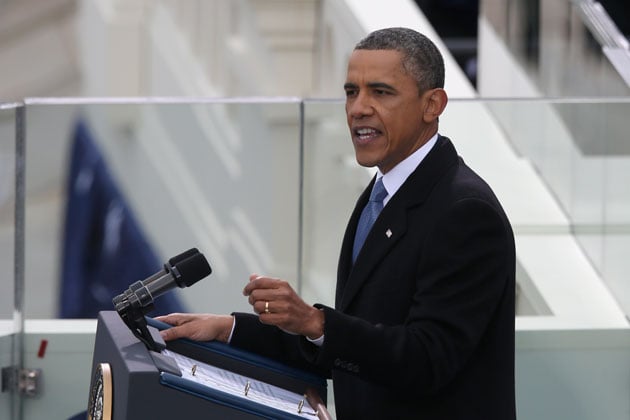
As
we did four years ago, we asked Richard Tofel, ProPublica’s
president and author of a
book on President Kennedy’s inaugural address, to provide
instant analysis of today’s speech. Here are his thoughts:
In 2009, in the
flush of his first election, Barack Obama declared in his inaugural
address that, “What the cynics fail to understand is that the
ground has shifted beneath them, that the stale political arguments
that have consumed us for so long no longer apply.” Today, perhaps
chastened by the trials of governing and the difficulty of gaining
election a second time, he did not so much acknowledge that the
cynics of 2009 had been right as devote himself to trying, one more
time, to move the ground beneath them.
The critical
portion of the address seemed to be this: “Progress does not compel
us to settle centuries-long debates about the role of government for
all time – but it does require us to act in our time…. We cannot
mistake absolutism for principle, or substitute spectacle for
politics, or treat name-calling as reasoned debate.” Whether such a
call, even with the president’s present strength and confidence,
will shift the ground will be the great question of the next period
in our politics and history.
The speech centered on the two fundamental American texts, the
Declaration of Independence and the Constitution. Obama quoted the
heart of Jefferson’s Declaration verbatim, and then turned
repeatedly, as his organizing rhetorical device, to the opening words
of the Constitution: “We, the People.” By the speech’s end,
seeking a call to action and perhaps a counterweight to the
polarization of Washington, “we, the people” became “you and I,
as citizens.”
Along the way, in addition to drawing
on the words of Jefferson and Martin Luther King, Jr., Obama managed
to reference Lincoln four times in two paragraphs, adverting to the
Gettysburg Address (“government of, and by, and for the people”),
Lincoln’s second inaugural (“blood drawn by lash and blood drawn
by sword”), the “House Divided” speech (“no union… could
survive half-slave and half-free”) and Lincoln’s second message
to Congress (“made ourselves anew”). The one source not quoted
in the speech, in a striking departure from inaugural tradition,
seems to have been the Bible.
Indeed, the speech overall was more
prosaic than most inaugurals. It was somewhat surprising, in this
context, to hear a defense of entitlements, a disquisition on climate
change, and calls for immigration reform and an end to voter
suppression legislation. In all of this, Obama’s model may have
been Franklin Roosevelt’s 1937 second inaugural—the first such
address delivered in January—which was a clarion call for liberal
politics and an attempt to cast it in the American mainstream.
Sixteen days later FDR over-reached with his Court-packing plan, and
his influence in domestic affairs began to ebb.
All of this reminds
us that second inaugurals are harder. The lofty hopes of
office-taking must give way to the sober experience of
office-holding. Nearly all of the immortal words of addresses past
come from first inaugurals: Jefferson’s “We are all Republicans,
We are all Federalists;” Lincoln’s “mystic chords of memory;”
FDR’s “firm belief that the only thing we have to fear is fear
itself;” Kennedy’s “ask not what your country can do for
you—ask what you can do for your country.” Only Lincoln’s
second inaugural—“with malice toward none”—lives on in the
same way.
And yet, second
inaugurals come from a place of strength. By definition, they can be
given only by presidents whose tenure has been validated again at the
ballot box. Of our 43 presidents (Grover Cleveland is both “22”
and “24”), Barack Obama is only the 17th to have had
the privilege of delivering a second inaugural address. (Another four
presidents won an election after succeeding to the office, which may
be similar, at least for these purposes.)
The first big
decision President Obama faced in crafting today’s address, I
think, was how rhetorical he wanted it to be. Obama came to the
presidency on soaring wings of rhetoric, from the “red states/blue
states” of the 2004 Convention keynote that introduced him to much
of the country, to the vision of post-racial triumph when he won the
Iowa caucuses in 2008, to his speech on race when the controversy on
Rev. Jeremiah Wright threatened to sink his campaign, to his outdoor
acceptance speech in Denver, to that unforgettable Election Night in
Grant Park.
In the face of all
that, many of us found his first inaugural somewhat muted, with its
Biblical injunction that “the time has come to set aside childish
things” and its command that “we must pick ourselves up, dust
ourselves off, and begin again the work of remaking America.”
Perhaps Obama had internalized Mario Cuomo’s observation that “You
campaign in poetry. You govern in prose.” Perhaps he had come
nearly to distrust the power of his own instrument. In any event, he
kept it largely under wraps during his first term, pumping up the
volume only occasionally (for instance in the critical congressional
address on health care), but often leaving his listeners with the
sense that he had fallen a bit flat, as in his second Convention
acceptance last summer in Charlotte, and almost disastrously in his
apparent failure to prepare a closing statement in his first debate
with Mitt Romney.
In recent months,
however, Obama has again seemed to find his voice—or to reach for
it. We saw this on Election Night 2012 and again in his speech at
Newtown. I began to expect that we would see it again in the
inaugural.
There were moments
of such poetry today, but they seemed outweighed by the prose. The
President’s calculation today seemed to be that the occasion
presented a chance—perhaps a last chance—to recall the political
system to what Lincoln, in his first inaugural address, called the
“better angels of our nature.” What the prospects are for such a
transformation, only the days ahead can reveal.