



The
federal government’s announcement last
week
that it would begin releasing data on physician payments in the Medicare
program seems to have ticked off both supporters and opponents of broader
transparency in medicine.
For
their part, doctor groups are
worried
that the information to be released by the Centers for Medicare and Medicaid
Services will lack context the public needs to understand it.
“The
unfettered release of raw data will result in inaccurate and misleading
information,” AMA President Ardis Dee Hoven, MD,
said in a statement to MedPage Today. “Because
of this, the AMA strongly urges HHS to ensure that physician payment
information is released only for efforts aimed at improving the quality of
healthcare services and with appropriate safeguards.”
On
the other hand, healthcare hacker Fred Trotter has raised concerns about CMS’
plan to evaluate requests for the data on a case-by-case basis. That isn’t much of a
policy at all,
he wrote, giving federal officials too much discretion about what to release.
So,
how is this all going to shake out?
Three
recent examples offer some clues.
The
first involves the Wall Street Journal and the Center for Public
Integrity.
The news organizations sued the government in 2009 to obtain records on
physician claims in Medicare. They received the information as part of a legal settlement,
but had to agree not to publish physicians’ names in most cases. They never got
a complete set of Medicare payment data. Instead, they received a 5 percent
sample of the Carrier Standard Analytic File, which includes records of
Medicare Part B (outpatient) billings and payments.
That
in itself was huge: In 2008 alone, it had about 42 million rows, each with 612
variables. It was about 38 gigabytes even before being imported into a
database, data journalist Maurice Tamman wrote in a legal declaration. At the time, Tamman was a Wall Street Journal news editor.
The
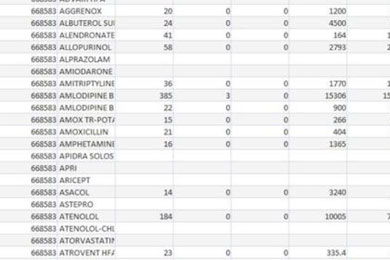
second example is the project that my colleagues at ProPublica and I have been
working on to examine how doctors and other health professionals prescribe
medications in Medicare’s drug program. Instead of seeking individual
medication claims, we sought aggregate records for each prescriber, grouped by
drug. We gave up some information we wanted, such as characteristics of the patients,
but we also were not subject to any limits in terms of our ability to name
doctors.
The
result is our Prescriber Checkup news application
that lets consumers look up their doctors and see how they compare to others in
the same specialty and state. Our stories identified examples
of risky prescribing, high rates of name-brand prescribing and patterns that
suggested fraud.
Even
though we did not have individual details on every drug claim filled—more
than 1 billion a year—the files we had were also vast: more than 70
million rows of data on the drugs prescribed by 1.6 million providers in 2011
alone. In cases in which a provider wrote fewer than 11 claims for a particular
drug, the data were redacted.
Finally,
healthcare hacker Trotter obtained data from Medicare on referrals to and from
providers within Medicare. He received statistics on the number of patients who
saw one doctor (Doctor A) within 30 days of seeing another doctor (Doctor B).
He’s created DocGraph to show these referrals
visually.
According
to his website, Trotter received
nearly 50 million pairs of referring parties involving about 1 million
providers in 2011. Like the data ProPublica received, Trotter did not receive
information on referrals in which fewer than 11 patients were involved.
Some
takeaways:
-
Medicare is far more likely to release aggregate information than data on
individual claims. This is mostly to protect patient privacy, but also because
officials have grown increasingly comfortable writing programs to aggregate the
data (as was the case with ProPublica and Trotter). -
Expect redactions. It’s safe to assume that Medicare will redact data in which
fewer than 11 patients are involved. -
Medicare likely will not create a glamorous news application in which consumers
can view the data. When the government released information on hospital charges last year, it
released a big spreadsheet and left it to news organizations and others (see here and here) to come up with
clever ways of displaying it. -
Medicare, likewise, is unlikely to put together tip sheets and other context
for interpreting the data. While the program should—and probably
will—release basic information about what is being released, officials probably
won’t tell consumers how much weight they should give it. -
There will be far more requests for Medicare physician data than there will be
Medicare staff assigned or available to fulfill them. -
Those wanting every morsel of Medicare data to be released will likely be
disappointed. This is a massive, immensely complicated program with many
interrelated parts. More information may be released each year, but it won’t
happen overnight. -
Finally, few news organizations or research groups are equipped to deal with
such large data sets and produce meaningful content quickly.
All
that said, let the data releases begin.
Editor’s Note: This post is adapted from Ornstein’s “Healthy buzz” blog.


