
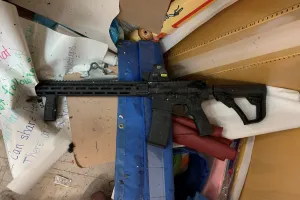
In mid-April, Kansas passed a law asserting
that federal gun regulations do not apply to guns made and owned in Kansas. Under the law, Kansans could
manufacture and sell semi-automatic weapons in-state without a federal license
or any federal oversight.
Kansas’ “Second Amendment Protection Act” backs up its states’ rights claims with a penalty aimed at
federal agents: when dealing with “Made in Kansas” guns, any attempt to enforce
federal law is now a felony.
Bills similar to Kansas’ law have been introduced in at least 37 other states. An
even broader bill is on the desk of Alaska Gov. Sean Parnell. That bill would
exempt any gun owned by an Alaskan from federal regulation. In Missouri, a bill
declaring federal gun laws “null and void” passed by an overwhelming majority in the state house, and
is headed for debate in the senate.
Mobilizing the pre-Civil-War doctrine
of “nullification,” these bills assert that Congress has overstepped its
ability to regulate guns — and that states, not the Supreme Court, have
the ultimate authority to decide whether a law is constitutional or not.
The head of the Kansas’s State Rifle
Association, an affiliate of the National Rifle Association, says she put the bill
together and found it a sponsor. While the NRA regularly lauds passages of
states’ gun-rights laws, it stayed silent on Kansas’ law, and, so far, has kept
a low profile on nullification. (The group did not respond to our requests for
comment.)
Many observers
see nullification bills as pure political theater, “the ultimate triumph of symbolism over substance,” as
UCLA law Professor Adam Winkler put it.
He
said he doubts the laws will ever be enforced,
and, if they are, expects them to be struck down by the courts.
Winkler and others say nullification
laws violate the Constitution, which makes federal law “the supreme law of the
land…anything in the Constitution or laws of any State to the contrary
notwithstanding.” Indeed, U.S. Attorney General Eric Holder wrote a letter last week to Kansas
Gov. Sam Brownback, asserting that Kansas’ law is “unconstitutional.” (Brownback,
who signed the bill into law, did not immediately respond to our requests for
comment.)
But the growing number of such bills —
which have passed by large majorities in at least one chamber of seven state
legislatures–highlight the challenge gun control advocates face in their
attempt to fight for gun regulation at the state level.
It also shows how nullification is fast
becoming a mainstream option for state politicians. In Pennsylvania, 76 state legislators signed on to sponsor a measure that would invalidate any
new federal ban of certain weapons or ammunition. The bill would impose a
minimum penalty of one year in prison for federal agents who attempt to enforce any new law.
Supporters of nullification are not
simply frustrated at what they see as congressional and presidential overreach.
During a hearing about one of the nullification bills she had introduced,
Tennessee State Sen. Mae Beavers called the Supreme Court a “dictatorship.”
“You
think that the Supreme Court is the ultimate arbiter of any of these laws. I
don’t believe that. I don’t believe it was ever granted the authority under the
Constitution,” Beavers was quoted as saying
in The Tennessean. (Reached by phone, she asked to comment later, then did not
respond to further requests.)
The Supreme Court rejected nullification in 1958, after Southern states tried
to use the concept to avoid desegregating public schools. “No state legislator or
executive or judicial officer can war against the Constitution without
violating his solemn oath to support it,” the Court ruled.
Winkler,
the UCLA law professor, said that even though the nullification trend was
likely to be ineffectual, “It represents a strong, powerful opposition to our
government.”
The concept of nullification has had a resurgence since the
beginning of President Obama’s administration. More than a dozen states have
introduced bills to nullify Obamacare.
The Tenth Amendment Center,
a group that advocates nullification as the solution to a range of policy
issues, from marijuana legalization to Obamacare, publishes model gun
nullification language. The
center has little direct contact with state legislators, Michael Boldin, the
center’s founder, said.
The roots of guns law nullification trace back nearly a
decade.
In 2004, Montana gun rights activist Gary Marbut drafted a
bill stating that any guns manufactured and retained in Montana are not part of
interstate commerce, and thus are exempt from federal regulation. The bill
failed twice, but it became law in 2009 after Republicans took control of the statehouse.
By Marbut’s count, at least eight states soon enacted “clones” of the
Montana law. (Those laws don’t go quite as far as
the more recent nullification legislation. For instance, most of them don’t
make it a crime to enforce federal law.)
The federal Bureau of Alcohol, Tobacco and Firearms
responded to the earlier laws with letters to local firearms dealers
explaining that federal laws and regulations “continue to apply.”
The
day the Montana law went into effect, Marbut filed
a lawsuit
in federal court asserting the right to manufacture weapons in the state
without a federal license. The suit, now before the Ninth Circuit Court of
Appeals, has been backed by a large group of supporters, including Gun Owners
of America, the Second Amendment Foundation, the Cato Institute, the Goldwater
Institute, and a group of nine
attorneys general,
some of them from states that had passed their own versions of the Montana law.
Representatives
of Goldwater and the Cato Institute said they see the case as not primarily
about guns. Instead, they say, it’s meant to persuade the Supreme Court to
rollback the Congress’ power to regulate commerce within a state.
“The
likelihood of victory is low,” said Trevor Burrus, a research fellow at the Cato Institute’s
Center for Constitutional Studies.
The latest set of
bills — including Kansas’ new law —represent a far broader and more
aggressive challenge to federal law. Even conservative organizations have been
skeptical of the trend.
“A state law that
criminalizes federal activity — I would oppose that as both imprudent and
wrong,” Burrus said. The Cato Institute’s chairman wrote an op-ed this spring
arguing this kind of nullification is invalid.
Goldwater Institute’s
Nick Dranias, a constitutional expert, said the term “nullification” is
sometimes applied to legitimate attempts to exert state sovereignty, “and
sometimes it is essentially lawless civil disobedience.”
States
should only pass laws challenging federal power “when there is a
reasonable legal argument for sustaining them,” he said. And the penalty
for enforcing federal law in “hard cases” should be “a
misdemeanor at most.”
The Heritage
Foundation, a conservative research group, released a “fact sheet” last year
titled “Nullification: Unlawful
and Unconstitutional.” (The fact sheet
does not address guns in particular.)
The Montana activist whose helped inspired
the nullification movement Kansas is also a bit skeptical. While he simply chose
to challenge the federal government’s commerce power, Kansas is “bucking
federal power more generally,” he said.
“I think, maybe tactically, they may
have gone a little further than they needed to,” Marbut said.
Though he supports the principles
behind the Kansas law, “I don’t know how much of that they can uphold when it
gets to the courts.”
But Marbut
hopes that the rapid spread of gun law nullification bills across the country
will encourage the Supreme Court to hear his case.
“I see the tide moving our way,” Marbut
said. “I think the Supreme Court has figured out that the people of America are
gathering their torches and pitchforks and it’s time to settle things down by
reeling in the federal giant.”
A spokeswoman for Alaska Gov. Parnell, who has not either approved or vetoed the
state’s nullification bill, said last month that “he is supportive of it.” But,
she added, “The bill (as with all bills that pass) is currently undergoing a
thorough review by the Department of Law.”
In Kansas, Patricia Stoneking, the
president of Kansas State Rifle Association, said she was recommending that
Kansans not start manufacturing guns under the new law until its legal status
has been clarified.
Even if Kansas’ law ends up being
struck down in court, “We actually are not going to roll over and play dead and
say, ‘Oh, no, shame on us,’” Stoneking said. “The fight will not be over.”