
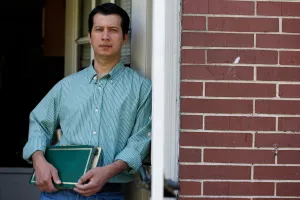
Update, Sept. 24, 6:27 p.m.:This story has been revised to include comments from Oscar Ramírez Castañeda.
U.S.
immigration authorities have granted political asylum to Oscar Ramírez
Castañeda, an illegal immigrant from Guatemala who learned only last year that
he was a survivor of a civil war massacre of 250 villagers in 1982.
Ramírez,
a 33-year-old father of four who lives near Boston, received a letter Saturday
from U.S. Citizenship and Immigration Services approving his application for
political asylum, his lawyer, R. Scott Greathead, told ProPublica, which reported on the case with
This American Life and Fundación MEPI.
Obtaining legal status opens a panorama of
opportunities to Ramírez after 14 years of living in the shadows. “I am
relieved,” Ramírez said in a telephone interview. “We are really happy. I am a
lot calmer now. I have been thinking, I have a lot of plans.”
Ramírez
filed the request late last year after a Guatemalan investigation proved that
he had been abducted as a 3-year-old by an officer in a commando squad that
wiped out the village of Dos Erres, one of the worst massacres in Guatemala’s
30-year civil war.
Ramírez’s mother and eight brothers and
sisters were killed, but the soldier’s family raised him as one of their own.
Last year, Guatemalan human rights activists traveled to the United States to
reunite Ramírez with his real father, a 70-year-old farmer who had survived the
massacre because he was in another town.
Recounted
in “Finding Oscar: Massacre, Memory
and Justice in Guatemala,” the story has become a high-profile
case in both the United States and Guatemala. After almost three decades of
impunity, authorities in both nations have pursued the
killers of Dos Erres, bolstered by DNA evidence proving
that soldiers abducted and raised Ramírez and another boy from the hamlet in
northern Guatemala.
Guatemalan
courts have convicted five soldiers, the first guilty verdicts for a massacre
in the conflict that ended in 1996, and are prosecuting former dictator Efraín
Ríos Montt as the mastermind. U.S. federal agents have caught four fugitive
commandos who migrated to the United States, including Jorge Vinicio Sosa
Orantes, a former Army lieutenant who was extradited Friday from
Canada to stand trial in Southern California on immigration charges related to
the case.
The
U.S. government’s decision to grant asylum status to Ramírez ratifies his claim
that he could be in danger of persecution in Guatemala. He is living proof of a
crime carried out by a military that retains great power in a nation racked by
lawlessness and corruption.
Ramírez’s wife, Nidia, also received asylum status as his dependent, according to a Sept.
19 letter from U.S. Citizenship and Immigration Services. The couple will be
eligible to apply for permanent residency in a year as well as obtaining work
authorization, Social Security cards and other benefits.
“This
makes them as normal and regular as they can be without being documented in
this country,” Greathead said. He said he believed the news coverage of Ramírez’s
case had played an important role in the approval of the asylum request.
Despite
his illegal status, Ramírez has managed to provide for his family by working
two full-time jobs, most recently as a supervisor at a fast food restaurant and
a cleaning company. He studied accounting in Guatemala and has training in
asbestos removal in the United States. He
routinely spends more than 16 hours a day working and commuting.
Now that he can function as a legal immigrant,
Ramírez no longer has to watch over his shoulder fearing discovery each time he
deals with officialdom or drives to work. He said he would like to study a trade,
perhaps as an air conditioning technician or a plumber. He also said he enjoys
working at the eatery. “In the future, I would like to have my own restaurant
one day,” said Ramírez. “With Latin food.”
His
real father, Tranquilino Castañeda,
spent the summer living with the family at their two-bedroom duplex in
Framingham, Mass. It was an enjoyable and emotionally powerful visit for all
involved, Greathead said. Castañeda’s visa allowed him to stay for a limited
period of time, and he is complying with the terms, Greathead said. He declined
to provide further details about Castañeda’s whereabouts because of security
concerns.
Ramírez said he is grateful to the U.S. government,
his lawyers and others who expressed interest and support after his case became
public. He said he feels inspired and relieved about the future.
“I’d like to find a job in which I can reach my full
potential,” he said. “And maybe in which I can have a little more time to enjoy
being with my family.”