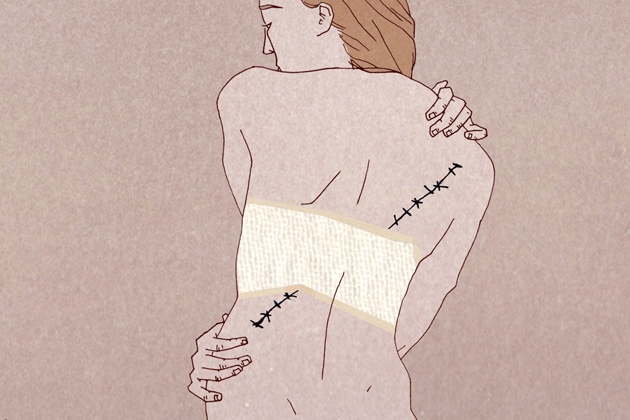

After surgery on her ankle, Jeanine Thomas suffered a potentially
deadly bacterial infection that required seven more operations to save her leg
and nearly five years of recovery.
Thomas found a medical malpractice attorney to file a
lawsuit on her behalf. But then he withdrew, she said, because he wouldn’t make
much money if they won. Thomas had just started a consulting business and
didn’t make much. Because economic damages in lawsuits are largely based on
lost income, she was told the potential rewards weren’t high enough, she said.
Thomas moved on. Now, she fights for better infection
prevention standards in health care through her advocacy organization, the MRSA Survivors Network. She was
one of dozens of readers who shared similar experiences in the comments section
for ProPublica’s recent story, “Patient
Harm: When An Attorney Won’t Take Your Case.”
Their stories cut across many dimensions of the problem, so we decided to
highlight a few. The excerpts below were edited for clarity, and
some writers did not provide their names.
As we reported, the medical malpractice system often
discriminates against certain patients, particularly those with low incomes. Those
who can’t get representation — often women, children or the elderly —
are sometimes called the “hidden victims” of medical malpractice. Studies show
that the problem isn’t limited to states that have strict limits on malpractice
awards.
In addition to commenting on the story, many readers
responded by filling out the ProPublica
Patient Harm Questionnaire or by posting to ProPublica’s Patient Harm Facebook
group. Both are part of our ongoing reporting about patient
safety, and we invite you to check them out.
1. “He was too old”
When my father passed from MRSA acquired after open heart
surgery (acquired either in the hospital or rehab center) I called 40 attorneys
and was told the exact same thing as the article states: He was too old, had
lost his viability (translate earning potential) and had no wife (she had
died). Most of them would not tell me why they would not take the case, but one
did. It’s not only hard to hear that your elderly parent has no value legally,
but this is exactly why doctors and hospitals and other medical facilities
continue their poor attempts at keeping hospitals as clean as possible. They
answer to no one.
— Carol Dye
2. “What was done to me was clearly negligence”
This is really so painful to re-live. All
of the attorneys I discussed my case with said that what was done to me was
clearly negligence and that the case had merit indeed. However, the potential
award would have fallen below the $250,000 mark, and to fight it would have
been a gamble because jurors – for whatever reason – see physicians
in a “can do no wrong” light and may decide in favor of the negligent doctor. I
wanted to fight it out of principle more than anything else.
— Gloria Shen
3. Rejection Letter
Our son’s case was a good example. There were many instances
of error, but because he was single we couldn’t bring case because there was no
“pain or suffering” allowed for parents of adult children over the age of 25. I
did call many attorneys and mostly was asked how old he was and if he was
married. Then I got a rejection letter. The solution is very simple. Be honest
when errors take place, and compensate victims fairly, then peace will come a lot
sooner for everyone, including doctors.
— John
4. “It was business”
I had the same issue after my daughter passed from medical
harm. I did at one point have a signed contract with an attorney. He had a
friend in the medical field that he felt could review her 2,500 pages of
medical records. However, when his friend explained that because she was an
infant who went in for heart surgery, you’d require two specialists to review
my daughter’s chart and testify. I was told it would cost roughly $50,000 to
$75,000 per specialist. This doesn’t include normal costs for the attorney. It
didn’t take long for the attorney to send me a letter stating he couldn’t help
me. I added that letter to the other dozen all stating we had a good case, but
the financial limits made it impossible for them to take it. It was business.
Although it was heartbreaking, I do understand the attorneys
cannot lose that kind of money on a case. I even asked if it were possible for
me to sign an agreement stating the attorney gets everything above expenses. I
didn’t want the money. I just wanted the hospital to have to own the mistakes.
As you read this, don’t assume she passed because of her
heart. The surgery was successful, as expected. It was the aftercare that
killed her: Avoidable infections, overdose of heparin, lines becoming dislodged,
a doctor collapsing her lung while removing a drain tube. It seemed endless but
was only 95 days. One heart surgery with a 99.9 percent success rate and a week
of recovery in the hospital turned into three heart surgeries, an exploratory
abdominal surgery and seven hospital associated infections and 95 days later,
her death. I wish there were a medical court (of sorts) that patients could go
to without an attorney. They could file a complaint and sit in a room with the
doctor, nurses, specialists and a panel of “judges” and plead their case. Ask
their questions. No attorneys. No “specialists.” Just a place to get answers,
and, if needed, monetary compensation. Personally, I just wanted answers.
— kratliff73
5. “Dad’s life was worth nothing”
My Dad was an elderly, and he was
killed by the misuse of an off-label medication that was contraindicative for
his medical conditions. The harm was totally preventable. After Dad’s death, we
talked to 20+ attorneys. 99 percent of them said there was malpractice and the
doctor was negligent. But because of my Dad’s age and the lack of future
earning, no attorney was willing to take my Dad’s case on contingency.
One attorney wrote to us that my
Dad’s age was above the average life expectancy, and therefore it “seriously
reduces the damages likely to be awarded for loss of future life earnings.
Certainly this does not excuse the poor care he received but this makes the
case economically untenable as the expenses will likely eat up the majority of
likely recoverable damages. We do not have punitive damages in Washington
(state) that an outraged jury could award to punish the Dr. and Hospital for
their callousness. For these reasons our firm does not wish to undertake this
case.”
So we learned quickly that, in our
current legal system, Dad’s life was worth nothing because he was old.
— Yanling
6. “I’ve never sued anybody”
I attempted to get recompense for my elderly mother after
medical neglect that resulted in her losing her ability to walk, additional
surgeries, and months of pain. I had no idea WHY the lawyers I contacted didn’t
even want to listen to the details. Now I know, and am disheartened to learn
the reason for their disinterest. I’ve never sued anybody, am not one of those
people who would sue when I dump coffee in my lap. But when one has a
legitimate reason and legitimate damages, it’s horrendous that our legal system
provides no avenue of recompense for actual damage that is life altering.
— Kathleen
7. “I am, however, alive”
I was an RN and suffered serious and permanent harm from my
cancer surgery. There were many errors, including my waking up during surgery,
life-threatening infection, internal sutures that did not dissolve, renal
failure, a collapsed lung after hospital discharge, abscesses and wound
dehiscence. Years later, I am homebound and unable to work. I would be making
$80-100,000/year now or more but am stuck barely above poverty on Social
Security Disability. Since I and the various insurances have spent over $2
million for my care, and I do not have enough money to obtain all the care and
medications I need, I am very unhappy. I have a potential new abscess now. It
is a living horror, and the cancer may return. I am always in pain. No attorney
would take my case. Even the failure to diagnose the cancer for years, with
facts right there for every doctor I went to with my symptoms, isn’t
actionable. I am however, alive.
— Nightmare-daily
8. “Perverse incentive”
We
got dropped the moment our attorney heard mom had died. It creates a very
perverse incentive when a hospital realizes that they have committed a serious
harm. The best thing it can do is kill you, which is precisely what we think
the hospital did.
— Debra Van Putten
9. “It was not cost effective anymore”
When I went back to work my lawyers dropped my case. It was
NOT cost effective anymore.
— Ron
Giovagnoli
10. “It would cost too much”
My younger brother died almost 2 years ago. He coded (his
heart stopped beating) a couple days after a colostomy procedure. The doctors
rushed him into surgery as he was clearly bleeding internally. They didn’t find
the source of the bleed, but after looking for a while, gave up and closed the
surgery anyway. He continued to bleed, which led to two more surgeries, more
complications and his eventual death.
We have had multiple lawyers look at the case. All of them
have told us that while they believe mistakes were made, it would cost too much
to prosecute the case to be worth it. Since he was 25, single and childless,
there are no financial losses; no one who was depending on his paycheck. All we
really want is answers and assurances that something has been done within the
hospital to prevent similar mistakes from occurring again.
— Jessamare