Gitmo and the Federal Judiciary: Our Coverage of the Habeas Lawsuits
The WikiLeaks documents released on Sunday night have raised again the legal and moral dilemma surrounding the indefinite detention of the Guantanamo prisoners, an issue that former ProPublica reporter Chisun Lee covered for more than two years. On Aug. 21, 2009 Lee wrote that the federal judges who were reviewing the habeas lawsuits filed by many Guantanamo inmates had found that more than half of the men whose cases they had completed at that point were unlawfully detained.
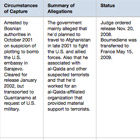
That story was accompanied by a chart containing documents and information about 53 Guantanamo detainees whose lawsuits seeking freedom had been decided by the judges. In a Jan. 22, 2010 article, three federal judges discussed their concerns about the Guantanamo cases in lengthy interviews with Lee.
Latest Stories in this Project
- Newly Released Memo Inadvertently Reveals CIA Held (and Abused) Missing Prisoner
- In Gitmo Opinion, Two Versions of Reality
- Appeals Court Makes It Easier for Gov’t to Hold Gitmo Detainees
- Obama Counterterrorism Adviser Slams Congressional Efforts to Block Guantanamo’s Closure
- Obama Makes Indefinite Detention and Military Commissions His Own
Get Updates
Our Hottest Stories
- Donations to Scott Walker Flagged as Potential Fraud
- In Race For Better Cell Service, Men Who Climb Towers Pay With Their Lives
- Billion Dollar Bait & Switch: States Divert Foreclosure Deal Funds
- Pardon Attorney Torpedoes Plea for Presidential Mercy
- Patient Died at New York VA Hospital After Alarm Was Ignored
- Introducing the ProPublica Patient Harm Community on Facebook
- Got Student Loans? Share Your Documents With Us
- Built for a Simpler Era, OSHA Struggles When Tower Climbers Die
- Remember Stuxnet? Why the U.S. is Still Vulnerable
- Congressional Leader Calls for Investigation of the Pardon Office
- Donations to Scott Walker Flagged as Potential Fraud
- Pardon Attorney Torpedoes Plea for Presidential Mercy
- Air Force Pilots Balk at Flying the World’s Most Expensive Fighter Jet
- In Race For Better Cell Service, Men Who Climb Towers Pay With Their Lives
- Patient Died at New York VA Hospital After Alarm Was Ignored
- Watchdog Group Calls for Probe of Lobbyists Behind Congressional Trip to Taiwan
- Billion Dollar Bait & Switch: States Divert Foreclosure Deal Funds
- N.Y. Congressman Will Reimburse Costs for $22,000 Taiwan trip
- Happy Graduation! Here's The Best, Most Depressing Journalism on Student Debt
- Remember Stuxnet? Why the U.S. is Still Vulnerable


1 comments
James B Stoprer
April 27, 2011, 2:18 p.m.
From “In Gitmo Opinion, 2 Versions of Reality,” 25Apr11, by Dafna Linzer:
“This censorship has nothing to do with protecting ‘national security’ and everything to do with covering up government mistakes and malfeasance” said Jonathon Hafetz, professor at Seton Hall’s law school, and familiar with Gitmo habeas cases.
The above agrees with what I (a simple layman) and others have posted here and there in various propublica comment sections. I believe it is the basis for perpetuation of this cruel and unjust Gitmo situation (and applies to the secrecy stamp in general).
The following is from “Judges Urge Congress to Act On Indefinite Terrorism Detentions,” 22Jan2010, by Chison Lee:
“How confident can I be that if I make the wrong choice that he (Gitmo defendant) won’t be the one that blows up the Washington monument or the Capitol.?” said Chief Judge Royce Lamberth, U.S. District Court, Washington D.C.
The Judge Lamberth statement, in generalized form, is surely in the thinking of all judges faced with guilty-innocent decisions on a daily basis. They are in the hot seat. I feel that the potential for recidivism is not valid in determining guilt and innocence. A person on trial for a ‘white collar’ crime of embezzlement should be judged on the facts of the indictment and trial, not on whether he is apt to embezzle again. It is the same with driving violations, assault, murder, drugs, etc. If the person thereafter builds up a record of repeat offending, then he is faced with increasingly harsher sentencing.
The problem with Gitmo is that Judge Lamberth’s statement is given credence above that of evidence concerning the matter at hand. This allows a person to be incarcerated for life. This, the unvalidated excuse of potential recidivism, coupled with the government’s fascination with ‘secrecy,’ results in a unhealthy view of our justice system. Most importantly, in my opinion, NO consideration is given to reasonably speedy and open trial and “beyond reasonable doubt”, which are basic to humane and democratic justice. NO consideration is give to the welfare of the prisoner.
Skartishu, Granby MO
Commenting on this story is closed.