


Here are this week’s must-read stories from #MuckReads, ProPublica’s ongoing collection of the best watchdog journalism. Anyone can contribute by tweeting a link to a story and just including the hashtag #MuckReads. The best submissions are selected by ProPublica’s editors and reporters and then featured on our site and @ProPublica.
In
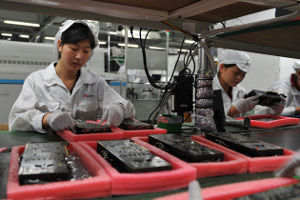
China, human costs are built into an iPad, New York Times
The
workers who assemble iPhones, iPads and other Apple products labor in
dangerous environments, but a radical overhaul would slow innovation.
Contributed
by @ericuman
Dispute
over drug in feed limiting US meat exports, MSNBC
The
controversial drug ractopamine has sickened or killed more pigs than
any other livestock drug on the market, leading the European Union
and China – which together produce and consume about 70 percent of
the world’s pork – to refuse to import meat raised on the
additive. The U.S. pork industry wants to change their minds.
Contributed
by @naomistarkman
Texas
hate crime law has little effect, Austin American-Statesman
A
decade after a Texas hate crime law was enacted, just 10 cases have
been prosecuted despite hundreds of hate-crime reports. Only one case
has gone to a jury.
Contributed
by @AASInvestigates
Washington
state is wasting millions to help sex predators avoid lockup,
Seattle Times
Two
hundred and eighty sex offenders in Washington State are locked up
indefinitely "as a way to protect society.” Under state law,
prisoners who are legally defined as "violently sexual
predators" are legally allowed to be detained after their
sentences are through. Part of a series.
Contributed
by James Neff
In
police training, a dark film on U.S. Muslims, New York Times
At
least 1,489 police officers have been shown an anti-Muslim film
during training, according to documents obtained by the Times. A top
police official denied in January 2011 that the department had used
the film, then said it had been mistakenly screened "a couple of
times" for a few officers.
Contributed
by Richard Tofel
Con
artist starred in sting that cost Google millions, Wall Street
Journal
Google agreed to
pay $500 million to avoid prosecution for aiding illegal sales of
pharmaceuticals. The settlement “signals that, where evidence can
be developed that a search engine knowingly and actively assisted
advertisers to promote improper conduct, the search engine can be
held accountable as an accomplice,” said to the lead prosecutor.
Contributed
by @kleinmatic
These
stories and many more can be found at ProPublica.
You can also subscribe
to a daily #MuckReads email or follow ProPublica
on Twitter. Reader submissions are key to making #MuckReads a
success — please
contribute!


